



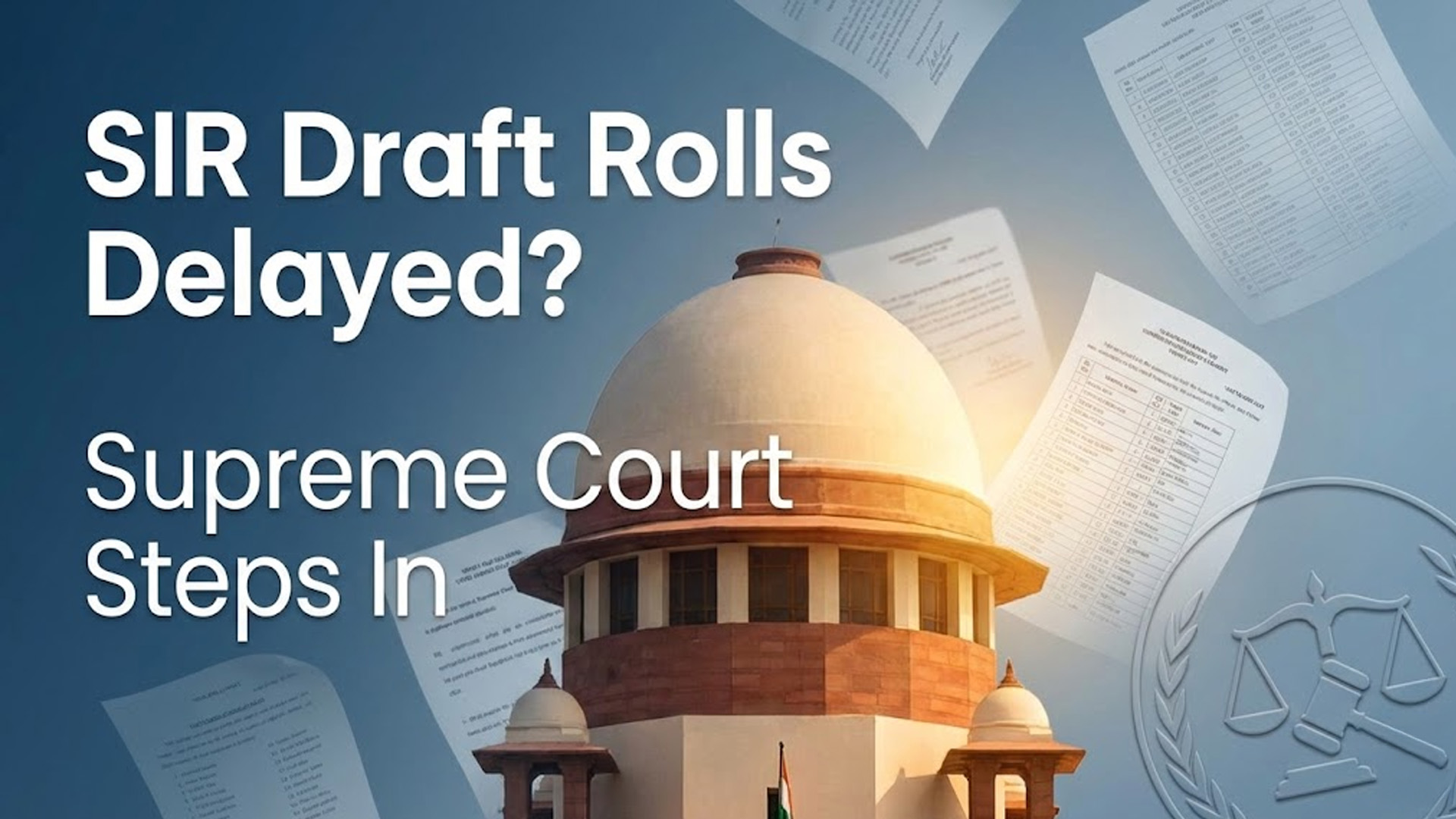
New Delhi — The Supreme Court on Wednesday (26 November 2025) signalled that it is open to extending the publication date for draft electoral rolls in states undergoing Special Intensive Revision (SIR), if a “case is made out” — a move that could significantly affect the ongoing SIR process in states like West Bengal and Tamil Nadu.
📌 What SC Said
During a hearing on petitions challenging the SIR exercise, the bench — led by Chief Justice Surya Kant and Justice Joymalya Bagchi — responded to concerns raised over its decision to list the next hearing for 9 December, which is also the scheduled date for the “draft rolls” publication under SIR.
Addressing petitioners, CJI Surya Kant said:
“So what? If you make out a case, then we can direct them to extend the date. Can that date be a ground for the Court to say that we don’t have any power now? Court can always say.”
In effect, the Court made it clear that the deadline for draft-roll publication is not sacrosanct — it can be postponed. The bench also asked the Election Commission of India (ECI) to file its counter-affidavit in the petitions from West Bengal and Tamil Nadu.
As things stand, the SIR-related matters from Tamil Nadu are listed for 4 December, while the West Bengal cases are on the 9 December roster. Additionally, petitions challenging the SIR in Kerala have been posted for 2 December.
🧑⚖️ Background: What is SIR & Why Is It Being Challenged?
The Special Intensive Revision is a nationwide exercise by ECI to update voter lists — revising electoral rolls to reflect changes such as migration, deaths, new voters, and deletion of bogus or ineligible entries. The current phase extends to several states and U.T.s, including West Bengal, Tamil Nadu, Kerala, Bihar, Puducherry, and others.
However, petitions filed by major political parties and civil-society organisations challenge SIR’s constitutional validity. They argue that SIR — especially with its new procedural guidelines — resembles a citizenship verification or registry exercise, beyond the ECI’s mandate, thereby infringing fundamental rights under Articles 14, 19, 21, 325 and 326 of the Constitution.
For example:
- In Tamil Nadu, parties such as DMK, CPI(M), and others contend that a recent Special Summary Revision (SSR) was held just months earlier (which concluded in January 2025). Conducting SIR again so soon, they claim, is unnecessary and burdensome — especially given the looming monsoon, harvest season, and festivals, which hinder voter participation.
- In West Bengal, petitioners argue the SIR could lead to mass disenfranchisement, especially affecting marginalised communities.
Given such serious objections, the Supreme Court’s readiness to extend draft-roll publication is being read as a signal that the Court is willing to consider deeper judicial scrutiny before allowing the SIR process to proceed.
⚠️ What SC’s Statement Could Mean — For Voters & Election Timeline
- Delay in Roll Publication: If the Court extends the 9 Dec deadline, ECI’s schedule could be disrupted, affecting the timeline for final roll publication and upcoming elections.
- Greater Judicial Oversight: Petitioners will get more time to argue their case; the Court may demand stricter safeguards, transparency, and accountability from ECI.
- Potential Freeze on SIR: High Courts previously hearing related writ petitions have been directed to keep them in abeyance until SC adjudicates — so a favorable SC order could stall or reshape SIR not only in WB and TN, but also other states.
- Impact on Citizens: Voters (especially in rural and marginalised communities) may face uncertainty regarding their status; citizens who intended to register or check their names could get caught in limbo.
🔎 What’s Next: The Road Ahead
- ECI must file its counter-affidavit on the petitions as directed by the Court.
- The Court will resume hearings on 4 December (TN cases) and 9 December (WB cases), only after which it may decide whether to extend the publication date or permit SIR to proceed.
- High Courts in states like Kerala, Bihar, etc., are likely to keep pending writ petitions on hold until SC’s decision.
- The final verdict could set a precedent — either reaffirming ECI’s power to conduct intensive roll revision, or placing stricter judicial checks to protect voters’ rights.