



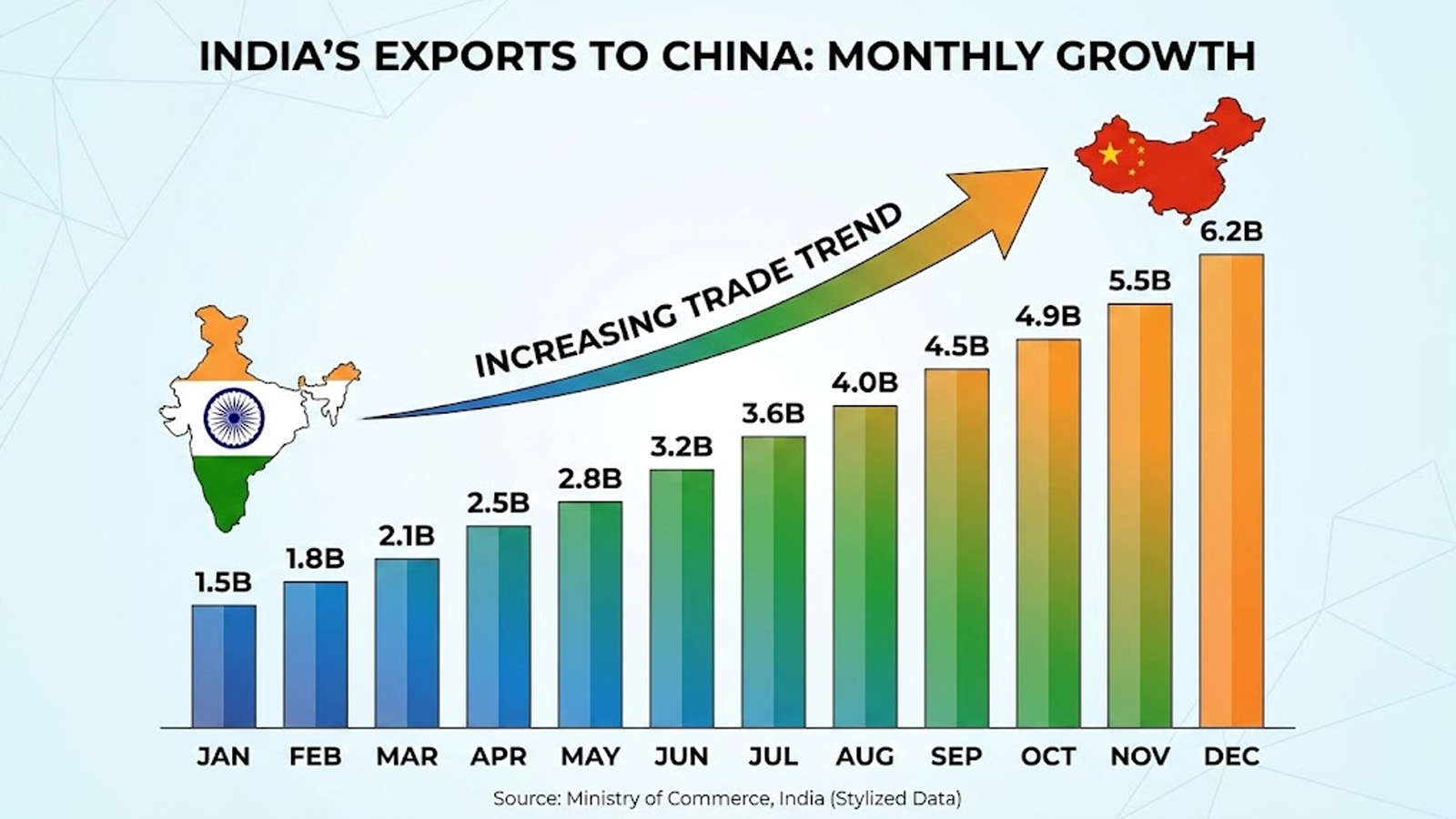
India’s goods exports to China have registered a consistent upward trajectory for seven straight months in the current financial year 2025-26, providing New Delhi with a valuable buffer amid rising external pressures, including tariffs imposed by the United States. Data released by the commerce ministry and reported by major business media show that exports to China grew year-on-year by an estimated 24.7 % for April-October, reaching approximately US$ 10.03 billion, with October alone posting a surge of 42 %.
This sustained growth reflects India’s strategic pivot in its trade policy — diversifying export destinations, tapping into alternative markets, and leveraging its strengths in sectors such as petroleum products, marine goods, and telecom instruments, which contributed significantly to the China bound shipment rise. Observers say the trajectory gives India some breathing room as it navigates the fallout from elevated U.S. tariffs on Indian exports.
Why the China Export Surge Matters
India’s export relations with China traditionally reflect a heavy dependency on imports from China and a persistent trade deficit. However, the latest data indicate a notable shift in the export dynamic. The fact that shipments to China have increased every month for seven months straight signals rising demand and improved export competitiveness — especially significant given the headwinds Indian exporters face in other markets.
With the U.S. imposing steep tariffs on Indian goods in recent months, this uptick toward China provides an alternate route for trade expansion. While China remains a complex trading partner, the growth of India-to-China exports offers a potential hedge against tariff shocks and geographic risk concentration in Western markets.
Which Sectors Led the Rise?
Trade sources highlight several categories driving the growth in exports:
- Petroleum products: Substantially higher shipments to China helped push up values.
- Telecom instruments: China’s demand for specialized telecom components played a role.
- Marine goods: Seafood and related products found increased purchase from Chinese importers.
This diversification beyond traditional labour-intensive goods toward higher-value industrial and resource driven exports is viewed as a positive structural shift for India’s trade profile.
Challenges and Cautions
Despite the promising trend, experts caution against over-celebration. India’s trade deficit with China remains large, and the absolute value of exports is modest relative to overall bilateral trade volumes. Moreover, dependency on a single destination or a narrow range of commodity exports can expose India to geopolitical risks and demand shocks.
There is also the question of sustainability: whether India can maintain such high growth rates for exports to China without reciprocal market access or structural improvement in supply chains and competitiveness.
Policy and Strategic Implications
The upward export trend to China dovetails with India’s broader trade strategy:
- Diversification of markets: Reduced reliance on any single destination.
- Leveraging commodity and resource strengths: India exporting what China still demands.
- Mitigating tariff risks: Alternate trade flows become important as the U.S. revisits its trade posture.
Commerce analysts suggest that New Delhi may now seek to deepen sectoral ties with China, while simultaneously ensuring that export growth is underpinned by compliance, value-addition, and upward movement in the value chain.
Outlook for FulYear FY26 and Beyond
If the current momentum continues, India could unlock record export growth toward China for FY26. However, given the global economic uncertainties, currency volatility, and geopolitical flux, exporters and policymakers alike are watching closely. Further steps such as expanding the PLI (Production Linked Incentive) scheme, strengthening logistics and trade facilitation, and securing stable bilateral trade frameworks are seen as essential.
City-based trade houses and industry associations emphasise the need for sustained support: consistent policy, better market access, stable supply chains, and resilience against external shocks.