



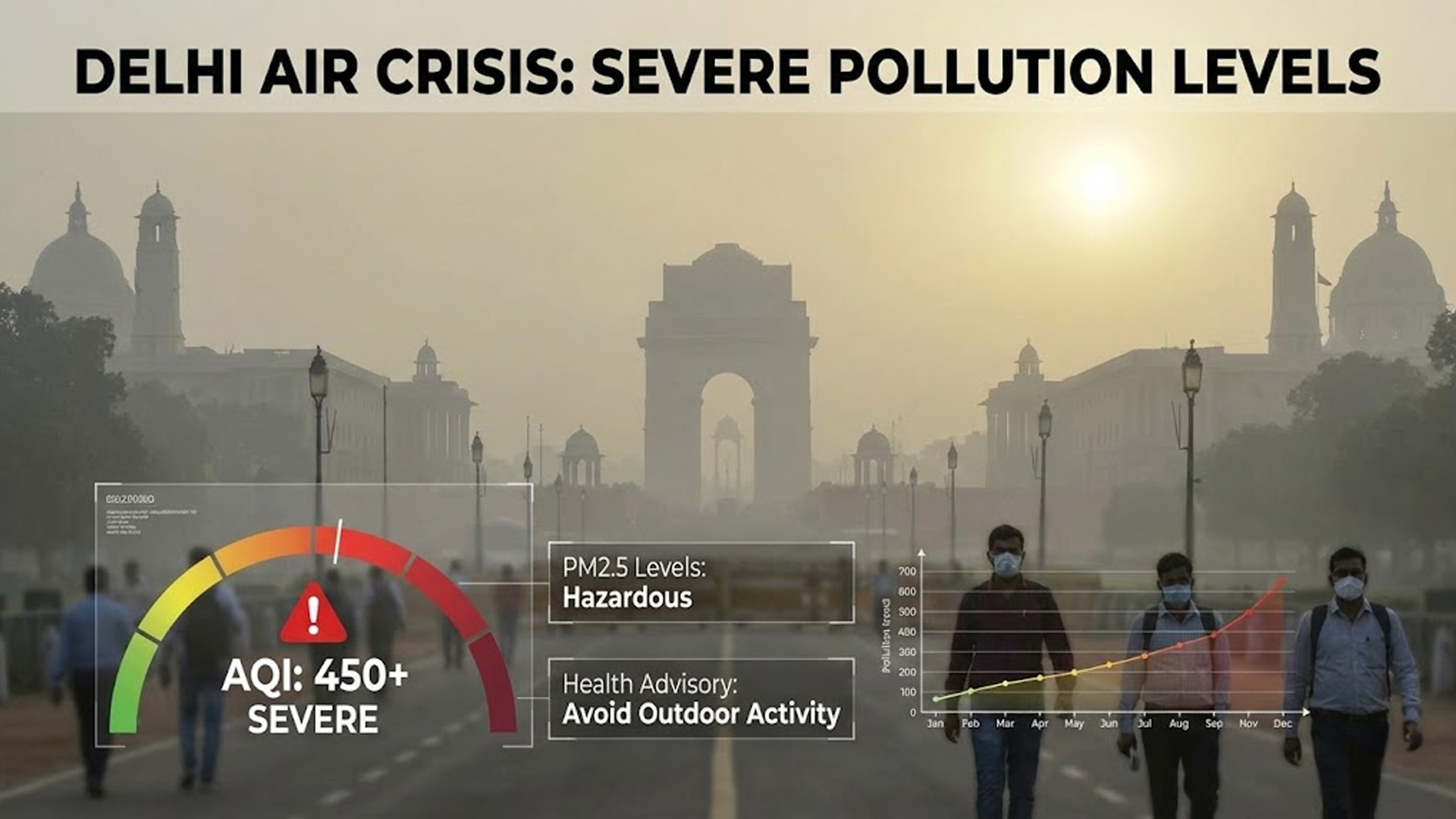
New Delhi: A new scientific study on Delhi’s air quality has delivered a stark message — only lockdown-level restrictions, similar to those imposed during the COVID-19 pandemic, can help the national capital breathe clean air by 2040. The findings reignite the long-standing concern over Delhi’s deteriorating air pollution levels, raising urgent questions about governance, sustainability, public health, and the future of India’s fastest-growing urban region.
According to researchers, despite several policy interventions in the past decade — including Graded Response Action Plan (GRAP) measures, construction bans, stubble-burning controls, and traffic restrictions — Delhi has not seen consistent, long-term reduction in pollution levels. The study highlights that PM2.5 and PM10 concentrations in the NCR region remain far above national and global safety standards for most months of the year.
The scientists stress that partial or seasonal curbs — such as odd-even schemes, construction bans, or temporary closures — barely make a dent. Only “continuous & aggressive interventions equivalent to COVID lockdowns” could significantly reduce particulate emissions and ensure Delhi meets global clean-air benchmarks by 2040.
🚦 Lockdown-Level Measures: What Do They Mean?
The study clarifies that lockdown-level curbs do not imply shutting down the city permanently, but implementing strict, sustainable versions of:
- 🚘 Drastic reduction in traffic volume
- 🏭 Major cuts in industrial and construction emissions
- 🌾 Eliminating stubble burning entirely
- 🔥 Complete ban on trash-burning
- 🚌 Mass-scale adoption of electric public transport
- 🏘️ Cleaner household fuels & energy-efficient housing
These interventions, if practiced consistently for over a decade, could help Delhi reach acceptable air-quality ranks by the late 2030s, according to experts.
🏙️ Why Air Pollution in Delhi Remains So Persistent
Despite multiple clean-air plans, Delhi faces complex, overlapping sources of pollution:
- Vehicular emissions rise annually as car ownership surges
- Industrial units in NCR often violate emission norms
- Construction dust remains uncontrolled year-round
- Winter stubble burning from Punjab & Haryana drives seasonal spikes
- Meteorological conditions trap pollutants due to low wind speed
- Household emissions from biomass still linger on NCR outskirts
Researchers note that even on “clean” days, Delhi’s AQI rarely falls below the “Moderate” category, indicating deep-rooted structural issues.
📊 What the Study Predicts for 2040
The study paints three scenarios for Delhi:
1️⃣ Business-as-usual
- AQI continues to worsen
- Severe pollution becomes more frequent
- Health diseases skyrocket
2️⃣ Strong but traditional interventions
- Minor improvements
- AQI stays in “poor-to-very poor” most days
- Gains wiped out easily by crop-burning season
3️⃣ COVID-like strict measures (sustainably implemented)
- 60–70% reduction in PM2.5 levels by 2040
- Consistent improvement across all seasons
- Delhi may meet national air-quality standards for the first time
🫁 Health Concerns Rising Fast
Doctors warn that Delhi is hurtling toward a public health emergency if transformative steps are not taken.
Common long-term effects include:
- Chronic coughs & bronchitis
- Severe asthma
- Lung cancer
- Heart diseases
- Stunted lung development in children
“Delhi children are growing up with lungs of a 60-year-old smoker,” said one senior pulmonologist quoted in the study.
🏛️ Policy Implications: A Tough Road Ahead
While the findings push for strict action, experts acknowledge that COVID-level curbs come with economic and social challenges. Policymakers would need:
- Massive investments in public transport
- Rapid electrification of vehicles
- Strict enforcement of industrial emissions
- Multi-state cooperation on crop-residue management
- Citizen participation at scale
Environmentalists argue that unless treated as a national emergency, Delhi’s pollution will remain a generational crisis.
🧭 Will Delhi Adopt Such Drastic Measures?
Officials indicate that while complete lockdown-style restrictions are unrealistic, incremental steps inspired by them — like:
- Weekend traffic control
- Permanent construction dust protocols
- Phasing out diesel vehicles
- Strengthening EV adoption
- Expanding tree cover
— could be part of Delhi’s future clean-air roadmap.
However, the study warns that unless such steps are intensive, long-term and continuous, Delhi may not see breathable air until 2050 or beyond.
Delhi’s pollution crisis is not new — but the new study underlines how far behind the city truly is in the battle for clean air. With winter pollution choking NCR again this season, these findings may push policymakers to revisit aggressive, science-backed solutions.
Until then, Delhi continues to gasp for relief — waiting for a future where clean air is not a luxury, but a basic right. 🌱🌏