



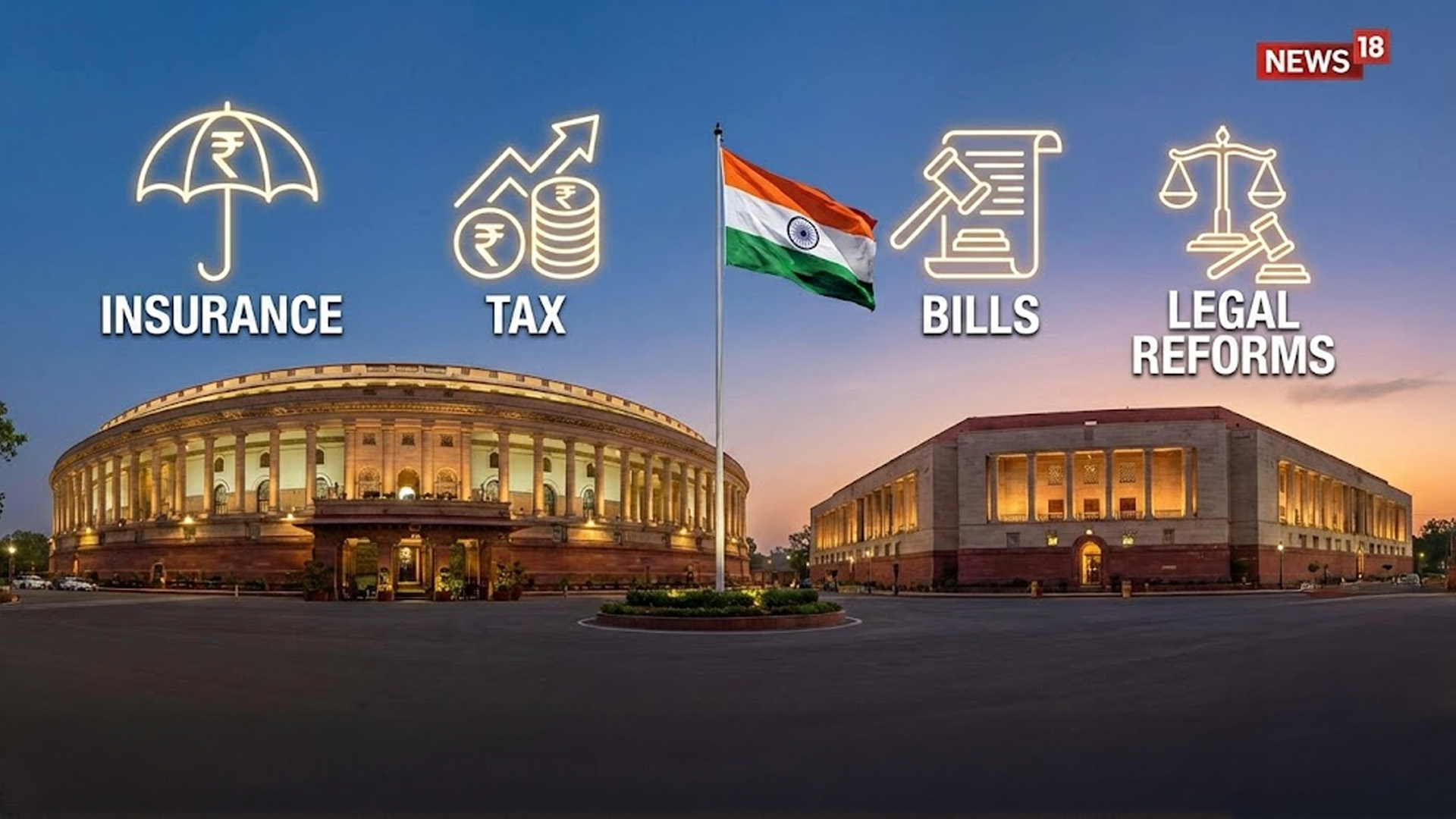
New Delhi: As the winter session of Parliament begins on 1 December 2025, the government has unveiled a sweeping economic-reform agenda. A total of nine major bills are slated for discussion — covering everything from insurance-sector liberalization to fresh taxation on tobacco and pan masala, and sweeping reforms across capital markets, insolvency, and corporate laws.
The session — lasting till 19 December — will also present the first batch of Supplementary Demands for Grants for fiscal year 2025-26, signalling possible reallocation of funds to match changing policy priorities.
📄 What’s Inside the 9-Bill Agenda
1. Insurance Laws (Amendment) Bill, 2025
Perhaps the most consequential, this bill seeks to raise the foreign-direct-investment (FDI) cap in the insurance sector from 74 % to 100 %. Supporters argue this will help attract global capital, fuel innovation in financial services, and improve insurance penetration across India.
2. Tax & Cess on “Sin Goods”:
Two critical bills — Central Excise (Amendment) Bill, 2025 and Health Security & National Security Cess Bill, 2025 — are expected to be introduced by Nirmala Sitharaman. These aim to replace the expiring GST compensation cess, reinstating high excise duties on tobacco, pan masala and related products. This move reflects government’s dual priorities: public health concerns and raising fiscal resources.
3. Securities Markets Code Bill, 2025
This bill seeks to consolidate multiple laws governing India’s capital markets into a single unified code — aimed at streamlining regulatory compliance, reducing complexity and boosting investor confidence.
4. Reforms to Insolvency, Corporate Laws & More
Other proposed legislation includes amendments to the Insolvency and Bankruptcy Code, 2025 Amendment Bill, corporate-law updates, and possible regulatory tweaks to the National Highways administration and Manipur GST rules.
5. Decriminalisation of Minor Offences: Jan Vishwas (Amendment of Provisions) Bill, 2025
As part of its push toward easing business-compliance burdens, the government is expected to decriminalise several minor offences under this bill — reducing red-tape and potentially spurring enterprise and investment activities.
💡 What It Means for Economy & Citizens
- More foreign investment: By liberalizing insurance FDI norms, India aims to attract global capital, potentially leading to better products and improved coverage.
- Revenue vs. health policy balance: While higher taxes on tobacco and pan masala will boost revenue, it may also impact small businesses dependent on those sectors. However, for public health advocates, it’s a welcome step to discourage consumption of harmful products.
- Simplified regulation: The consolidation of capital-market laws and corporate-law reforms may reduce legal complexity and encourage new startups and businesses.
- Ease for businesses: Decriminalisation of minor offences could improve the ease of doing business, especially for MSMEs and small enterprises that often suffer from heavy compliance burdens.
At the same time — opposition parties have indicated that this session may become contentious. Alongside economic bills, the government is expected to raise controversial items like electoral roll revision laws, which the opposition is prepared to challenge aggressively.
🔭 What to Watch Closely
- The exact wording and approval of the insurance-FDI bill — would 100 % FDI lead to dominance of foreign capital, or balanced growth?
- Impact of new cess/tax rules on tobacco and pan masala consumption, small businesses, and related industries.
- The fate of the Securities Markets Code Bill — will simplification lead to more investor confidence and liquidity?
- Whether reforms around insolvency, corporate law and decriminalisation get smooth passage or face pushback from interest groups.
- Parliamentary dynamics: with multiple bills and contentious issues, the session could see widespread debate, negotiation and possible deadlock on certain matters.
In short — the 2025 winter session has the potential to reshape India’s economic landscape substantially.