


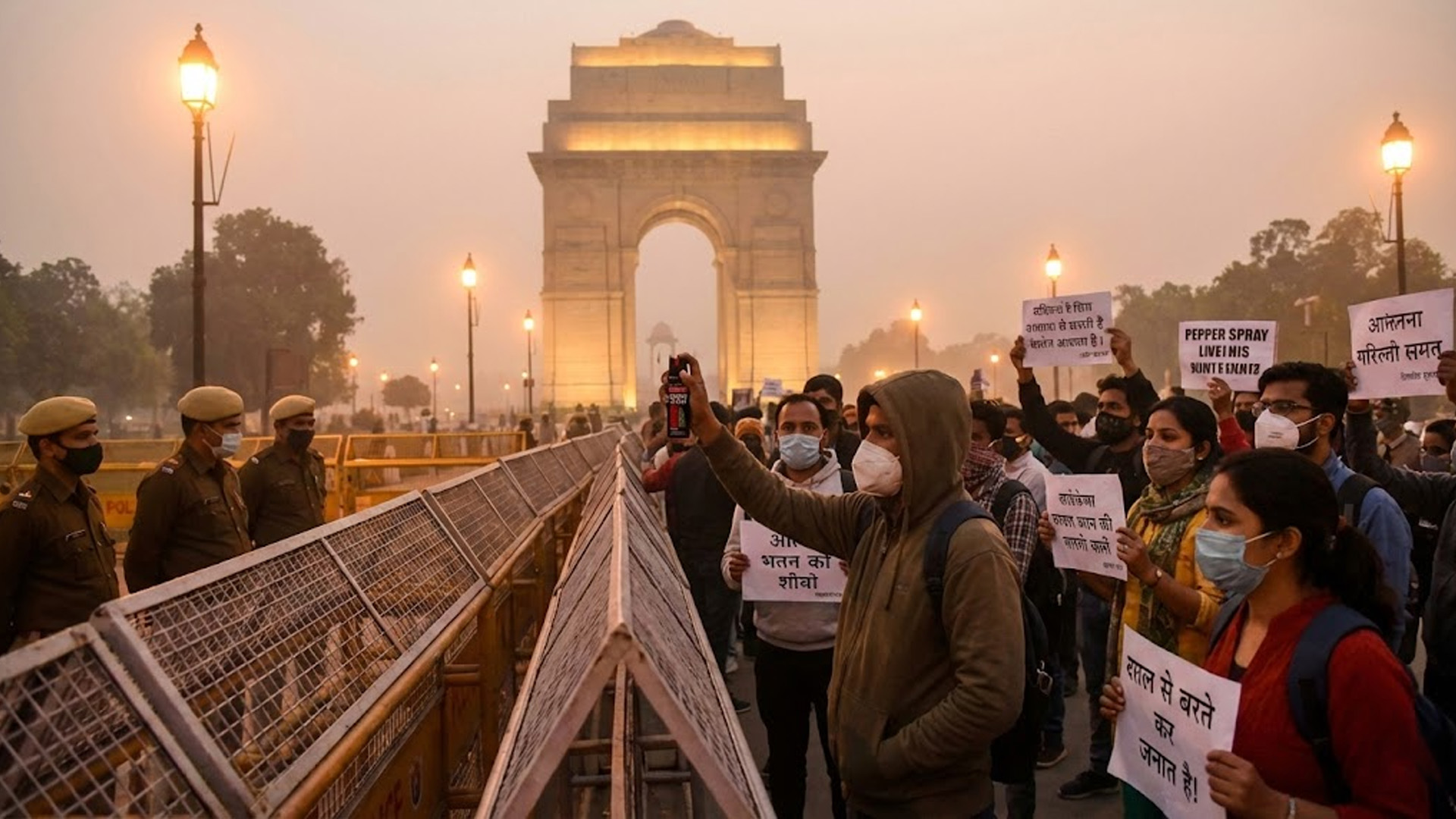
A protest on Sunday near India Gate in New Delhi over the city’s worsening air quality escalated into violence when demonstrators allegedly attacked police officers with pepper spray. The confrontation occurred when the crowd refused repeated orders to disperse and blocked Man Singh Road, prompting law-enforcement to detain 15 people, including several activists, the Delhi Police said.
The protest, organised to demand urgent action against toxic air in the national capital, descended into chaos when police attempted to clear the site and restore traffic flow. At least three officers required treatment after exposure to the pepper spray, according to official sources.
What Happened?
Around mid-afternoon, a group of citizens — including parents, students, and environment-activists — gathered at the prominent India Gate monument to demonstrate against what they described as an “air emergency” in Delhi. The city’s Air Quality Index (AQI) was hovering around 390-400, categorised as ‘very poor’ or bordering on ‘severe’.
Despite multiple warnings from the Delhi Police, the protesters remained at the site, refusing to shift to Jantar Mantar — the designated protest zone. When police began enforcing dispersal, a section of the crowd reportedly brandished pepper-spray canisters and used them against officers. The ensuing skirmish lasted several minutes until additional forces arrived and made the arrests.
Why This Protest Turned Violent
Analysts say the protest’s escalation reflects broader frustration among Delhi residents over years of inaction despite recurrent toxic air episodes. Some key factors:
- High AQI levels: With readings repeatedly exceeding 350-400, residents expressed that they were “breathing for survival”.
- Perceived delay in policy responses: Many felt that despite official plans (like GRAP measures) being in place, enforcement was weak and visibility of action minimal.
- Location choice and traffic disruption: The choice of India Gate and subsequent roadblock heightened tension as commuting motorists and police attempted to maintain order.
Legal experts emphasise that while public protest is a legitimate right, using force or weapons (including pepper spray) against officers crosses into penal territory and leads to legal consequences.
Police Response and Legal Fallout
According to Delhi Police:
- 15 individuals were arrested; more are likely to be detained as investigations continue.
- Injured officers (three to four) were taken for medical treatment after exposure to pepper spray. The
- A case is being registered against accused persons for assaulting public servants, obstruction of duty and other related offences.
- Police reiterated that the protest site was not authorised and that repeated warnings were issued.
Authorities said the investigation will include examining videos and mobile phone data to identify people who carried or used pepper-spray, and to determine whether the protest was infiltrated by radical elements.
Implications for Air-Quality Activism and Governance
The incident adds complexity to the dual challenge faced by the Delhi government and NCR agencies:
✅ The activism dimension
Public fatigue over recurring air-pollution crises is translating into more direct and confrontational forms of protest. But when demonstration turns violent, it can undermine credibility and complicate dialogue with policymakers.
✅ The policy dimension
Officials are under pressure to accelerate enforcement of the latest revised Graded Response Action Plan (GRAP) measures, monitor hotspots, clamp down on emissions and enhance public engagement.
✅ A test of law-and-order balance
Managing civic unrest during high-emotions protests — in this case over pollution affecting children, older adults and public health — demands measured policing. The use of pepper spray by protesters complicates legitimate claims of victimhood and raises new enforcement challenges.
What the Government and Activists Plan Next
Activists say they will regroup and hold a bigger demonstration later this week, with demands including:
- immediate activation of GRAP-IV level measures
- transparency of air-monitoring data
- free health camps for affected children and elders
- stricter enforcement of vehicle, dust, and industrial emission laws
The Delhi government said it was reviewing the event, reaffirming that protestors must shift to designated areas and that public safety remains paramount. A senior environment official stated that the AQI trend would be watched closely in the coming days and that additional restrictions might be triggered if levels hit ‘severe’.