



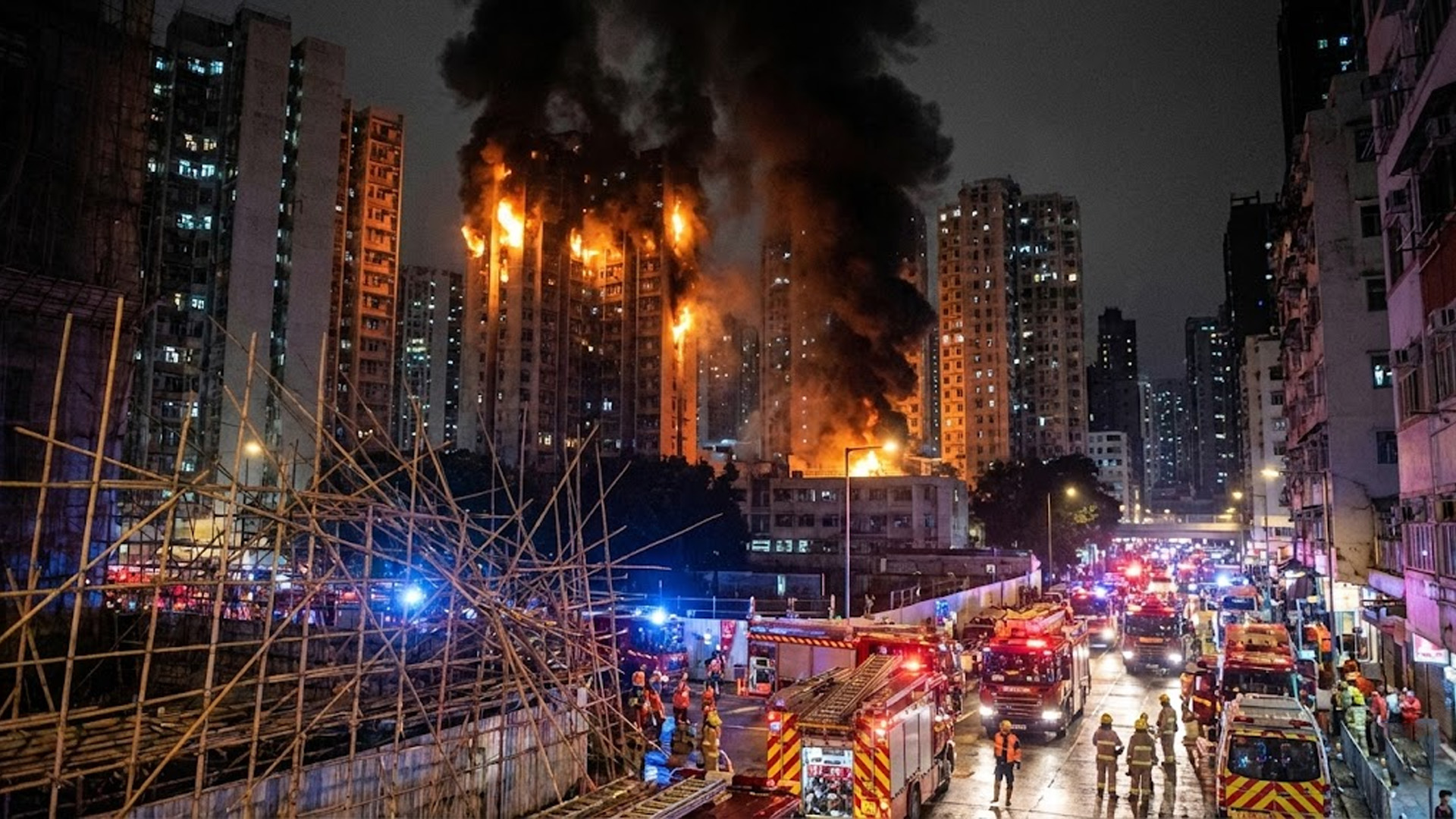
A devastating blaze ripped through a multi-tower residential complex in Hong Kong’s Tai Po district on Wednesday, leaving at least 44 people dead and nearly 300 unaccounted for — marking the deadliest fire in the city in decades. The inferno engulfed several 32-storey blocks of the Wang Fuk Court housing estate, spreading at lightning speed and trapping residents inside.
Authorities have launched a massive rescue and investigation operation. Firefighters continue combing through smoke-choked apartments as police have arrested three men, including two company directors and an engineering consultant, on suspicion of manslaughter over alleged gross negligence in using flammable construction materials.
🔥 How the Blaze Unfolded — A Deadly Cocktail of Risks
The fire broke out around 2:51 PM (local time) on Wednesday at Wang Fuk Court, which comprises eight high-rise towers and around 2,000 apartments. The complex was under renovation, wrapped in bamboo scaffolding and green construction mesh — both of which turned out to be catastrophically flammable.
Inside the buildings, investigators found styrofoam-based cladding and waterproof sheeting — materials suspected to have accelerated the blaze’s spread. The fire’s intensity and rapid vertical and horizontal spread were described as “unusual” by officials.
In just a few hours:
- Flames engulfed seven of the eight towers.
- The fire alarm was quickly escalated from Level 1 to Level 5 — the highest — underlining its severity. Al Jazeera+1
- Thick smoke and raging flames prevented rescue crews from reaching many upper floors, complicating evacuation efforts.
📉 Casualties, Missing Residents, and Ongoing Rescue
- 44 people confirmed dead, among them a firefighter responding to the blaze.
- 279+ people reported missing or uncontactable as of early Thursday, sparking frantic search-and-rescue efforts.
- Dozens are also hospitalized, with many in critical condition.
- By early morning, rescue operations had brought flames under control in some blocks — but fire still smouldered in others, and search teams worked floor by floor.
Nearly 900 displaced residents have been moved to temporary shelters, while emergency services — including dozens of fire engines, ambulances and hundreds of first-responders — continue efforts to locate survivors.
⚠️ Negligence Under the Scanner — What Went Wrong?
Preliminary investigations point to gross negligence as a likely cause. The arrested men are suspected of using non-fire-resistant netting and cladding, sealing windows with styrofoam, and employing bamboo scaffolding — despite ongoing city-wide calls to phase out such materials.
Senior police officials have indicated these lapses “caused the fire to spread uncontrollably,” resulting in large-scale casualties.
The tragedy has triggered wide public outrage, especially given Hong Kong’s chronic housing shortage and the ongoing pressure on authorities to enforce stricter safety regulations.
🏘️ Housing, Safety, and Public Outrage — Bigger Questions Loom
Wang Fuk Court was part of a subsidised home-ownership housing scheme — occupied by thousands of low and middle-income families. The fire has exposed lingering vulnerabilities in building-safety norms, particularly in older apartments undergoing renovation.
Public anger is mounting. Residents, activists, and analysts are demanding:
- Immediate suspension of bamboo scaffolding and unsafe construction materials
- Retrofitting and safety audits of older housing towers
- Accountability for contractors and local authorities responsible for oversight
With upcoming local elections in Hong Kong, the disaster may also reshape political discourse around housing, safety standards, and governance.
🔎 What Next: Rescue, Investigation & A Nation in Mourning
Officials have launched a criminal probe. The city’s top leadership, including Chief Executive John Lee Ka-chiu and Chinese President Xi Jinping, have pledged full support to rescue efforts and a transparent inquiry.
Meanwhile, hundreds of families remain uncertain of their loved ones’ fate. As smoke clears, the larger damage — human, social and psychological — is beginning to emerge. The tragedy stands as a grim reminder of the costs of lax safety standards in urban housing.